Insights
Everyone Tracks Renewals Now. The Number Is Still Wrong.
September 17, 2026 · Ameet Kulkarni
Ten years ago the renewal problem was simple: customers went missing from the report. The industry fixed that. ARR, NRR, and GRR sit on every board deck now.
But what I have been observing is that the 2026 problem is different. The customer is now in the report but the number attached to their name is wrong.
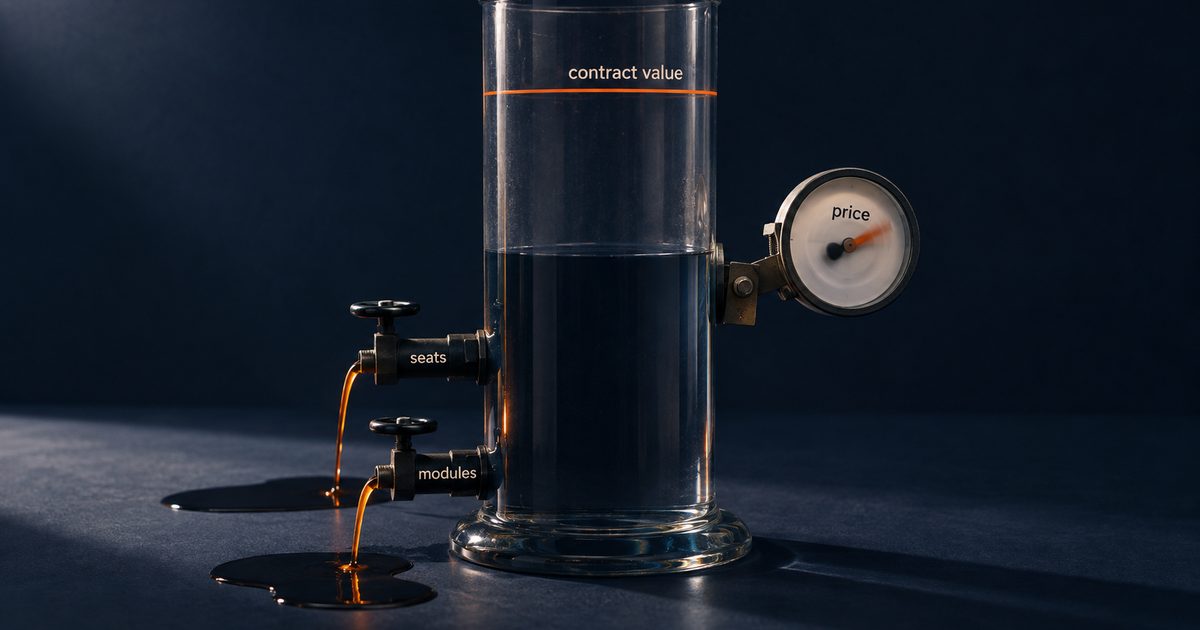
That number is the current contract value, rolled forward twelve months. It assumes the same seats, the same modules, and the same price. Every force below pushes on one of those three, and none of them pushes back without a deliberate expansion motion. Two push the number down. The third just makes it unreliable. So the errors do not cancel the way forecast errors are supposed to. The renewal line is therefore a ceiling that gets reported as an expectation.
Three ways the number gets inflated
The forecast reads dates, not usage. Most renewal forecasting still runs off the contract end date and a CRM stage field, with a CSM’s gut feel on top, rather than the usage and support signals that actually predict the outcome (ORM). A calendar date tells you when the conversation happens, not how it goes, and the value sitting beside that date is last year’s.
The customer’s world moved, and it moved down. AI is compressing seat counts even at healthy, well adopted accounts. Atlassian reported its first ever decline in enterprise seat counts in early 2026, driven by customers replacing seats with agents (Digital Thought Disruption). Multi-year contracts signed in 2021 and 2022 are landing now, sized for a headcount that no longer exists, and the whole correction arrives at once. Shelfware nobody flagged for two years gets found the week the quote goes out, and the customer brings the reduction list. Modules go the same way. A bundle bought three years ago almost always contains something never switched on, and the renewal is where the customer prices it. Every one of those is a quantity cut against a forecast that assumed the quantity held.
And the price list itself keeps moving.
The price keeps moving under the forecast
Leaders at fast-growing software companies now describe iterating pricing several times a year, and are candid that their revenue infrastructure was not built for that pace. As one put it, there are “really not enough people to manage it” any other way (Stripe).
Two consequences follow. Internally, the system of record for who renews, when, and at what price changes underneath the forecast itself. A renewal number built in March against a price list that changed in June is not stale, it is wrong, and nothing in the CRM flags it. Externally, the customer arriving at renewal has already watched the price list move, and reads the new quote skeptically before the rep says a word. The price list has started the conversation adversarial on the vendor’s behalf.
Ownership keeps moving, and moving it does not fix it
The industry still has not settled who owns the renewal. Jason Lemkin has said publicly that customer success “morphed into part of the sales team” through 2023, as companies folded renewal quota into account executive roles to cut headcount (SaaStr). I have watched a version of the same move up close more than once. In one case the renewals were handed to the sales reps outright. In another, the customer success reps were “embedded” into the sales team, reportedly copying a larger SaaS vendor’s playbook. The friction showed up fast both times, in comp arguments and in customers who no longer had a name to call.
An organization does have to settle how renewals are handled. But the friction I saw was not a sales problem or a CS problem. Reassigning the renewal to a different job title does not change what that title reads.
Security and infrastructure carry their own version of this
Platform consolidation is the biggest lever in security renewals, and it is worth being clear where the gains come from. Palo Alto’s platformization push, trading multi-year commitment for bundled pricing, has produced a cohort running 119 to 120 percent net retention while the median SaaS company sits barely above 100 (Longyield). Every point above 100 came out of somebody else’s renewal line. A customer collapsing three point products into one platform does not churn gradually or read as an unhealthy account. They renew on schedule until the quarter they do not renew you at all.
Most vendors cannot see it coming. Accounts sold through an MSP put the vendor a step removed from the usage signal. The MSP leaders I have talked with say renewal season has become the hard part of their year, and that the way a customer gets kept is usually through a heavy discount. The vendor sees none of it until the invoice shrinks.
The honest forecast lives in product
If moving the renewal between job titles does not fix the number, the only thing left to change is the input. Entitlements, packaging, the price book, and usage telemetry are the inputs that would make the number honest, and all four already sit with product. That is not a claim about org charts. It is a description of where the data is.
None of which makes renewals a product function. Product should not own the renewal. What product owns is the data the number is built from, and whoever carries the renewal, a rep, a CSM, or a dedicated renewals manager, should be taking their inputs from product rather than from a contract record.
The practice worth building is specific: feed the forecast from usage and health signals 120 to 180 days out, not 30. Treat product’s data as the source of truth over the CRM stage field. Log every pricing change as a renewal event with customers attached, not a surprise found at the worst moment. And report the line as a most likely and a floor rather than the contract value. A single number that can only move one direction is not a forecast.
A renewal number is only as honest as the system that produced it, and no amount of reorganizing sales and CS will make a bad system tell the truth.